Alibaba Offers Bitcoin Rewards Through Lolli Shopping App for ‘Singles Day’
Posted by Leigh Cuen Nov 11, 2019
Lolli, an affiliate retail startup that gives online shoppers bitcoin instead of regular cash-back perks, just announced its first Asian partnership with Chinese e-commerce giant Alibaba.
Lolli’s in-browser app allows users to shop through merchants’ websites as they normally would, but earn small bitcoin rewards delivered to the in-browser wallet.
CoinDesk reached out to Alibaba for comment and will update the article if we hear back.
This announcement comes on Singles Day, the Nov. 11 Chinese shopping holiday comparable to the U.S.’s Black Friday. Alibaba Group’s online Singles Day sales have reportedly generated more than $23 billion so far this year.
However, Lolli’s head of communications, Aubrey Strobel, told CoinDesk that Lolli perks will only be available to purchases made in the U.S. For Chinese-Americans, foreign students or travelers, this new option could add additional perks if they participate in online holiday sales, but residents in China will be unable to participate.
“Its products would be shipped from China to U.S. users,” Strobel said.
Lolli CEO Alex Adelman referred to this partnership as a milestone for the startup, which plans to expand internationally in 2020.
“This partnership is a great first step to connect the two largest economies, China and the US, through bitcoin and commerce,” he told CoinDesk. “The opportunity is available for US users only for now but we plan to expand internationally soon, letting everyone in the world easily earn and own bitcoin.”
Stepping back, several cash-back crypto startups are gearing up for the holiday shopping season. There are now several bitcoin retail apps, including competitors like Fold, Pei and SPEDN, targeting customers over the 2019 holiday shopping season, offering more bitcoin options than in previous years.
Bitcoin Price Will See $16,000 ‘Soon-Ish,’ Predicts Binance CEO CZ
Posted By Adrian Zmudzinski – CoinTelegraph

Changpeng Zhao, the CEO of major cryptocurrency exchange Binance, says a price of $16,000 per Bitcoin will happen “soon-ish,” in a tweet sent on Nov. 1. Zhao explains that price predictions are easy, but getting the timing right is hard.
He said:
“Lol, price predictions are easy. It’s just hard to be right about the timing. We will see $16k soon-ish. 1.4 billion people working on it as we speak.”
The message was an answer to the tweet of another user who pointed out that the prediction of an anonymous 4chan user predicting Bitcoin’s price would hit $16,000 by the end of October turned out to be wrong. The given prediction also stated that BTC will hit $29,000 in the first quarter of next year, $56,000 in Q3 2020 and $87,000 in Q4 2020.
At the same time, other predictions are actually less modest. John McAfee, for example, doubled down recently on his $1M Bitcoin by 2020 prediction, arguing that Bitcoin’s next price surge will be triggered by its scarcity.
As Cointelegraph reported, the Bitcoin network mined its 18 millionth BTC last month, which means there are only 3 million BTC not yet in circulation.
Bitcoin Automated Trading System

So what is exactly that Bitcoin Auto-trading system everybody is talking about?
Making money from trading is why we are all here. But being online and trading for hours on either your PC or mobile app can also be time consuming. Traders spending hours online and trying not to miss any market opportunity that can help them earn money can sometimes be an overwhelming situation … Not to mention the amount of financial market knowledge you need to have to place the right trades at the right time that will eventually earn your money…
What if I were to tell you that trading online doesn’t necessarily have to be a confusing and overwhelming experience? That you can say goodbye to endless financial analyses and can enjoy trading using a safe and easy-to-use automatic statistical method? How about feeling like your own personal Broker as you will be in total control of your own trading experience?
The Auto-trading system!
What is it?
Auto-trading system gives you the ability, to place trades automatically on any financial assets and in the trading volumes you choose, when you are not next to your PC or mobile phone. Not only that, the BATS offers you full risk management with the “Take Profit” and “Stop Loss” features. These features let you set your desired daily profit and loss, and once the BATS reaches that amount, it will pause itself for the rest of that day and resume the day after.
A known fact is that 95% of successful deals in the financial markets globally are made by Auto-trading systems/trading algorithms.
What is the success rate of the Auto-trading system?
Ah, that is the million-dollar question, isn’t it?
Can this Auto-trading system make me money?
First, there is NO such thing as a “magic robot” that earns money consistently, as there are no free gifts in life. If there were, everybody would be using it already. Any company or salesman that promises you that their “robot” will earn big money consistently is basically lying to you.
Now that we have established that, we can move on.
Success rate changes on a daily basis and based on market conditions.

How can I get a high success rate on my BATS?
The combination of the trading strategy that you choose and your attention to the volatility of the asset you are trading on. Volatility means the frequency of the movement in the price of the asset.
“The trend is your friend” . This is the rule of law for many traders. Following the trend is one way traders attempt to predict the future direction of an asset’s price. The Auto-trading system is using the trend as a signal indicator.
“Trend” strategy goes better with less volatile assets.
Less volatile assets go well with a “Trend” strategy because it exploits the MILD movements in the asset’s price. If the asset is less volatile, it means that statistically there is a higher chance that the price of the asset will continue in the same trend. The “Trend” strategy will automatically buy the asset if it reaches a new high point.
“Reversal” strategy goes better with more volatile assets.
More volatile assets go well with a “Reversal” strategy because it exploits the SHARP movements in the asset’s price. If the asset is more volatile, statistically there is a higher chance that the price of the asset will reverse its trend. The “Reversal” strategy will automatically buy when the asset reaches a new high point.
Let’s take an example of a two-week period to understand.
In the first week the Bitcoin is more volatile, so the “Reversal” strategy is more successful than the trend (above 80%), because the Bitcoin is volatile and the “Reversal” strategy is able to exploit it. The following week the Bitcoin is much less volatile, so the “Trend” strategy is much more profitable (above 85%!). But one needs to understand that it doesn’t say that this is a guarantee, and although it is an Auto-trading system (NOT A “MAGIC ROBOT”) you need to be alert to market conditions and asset volatility and react to it. if you follow these guidelines you can significantly increase your chance of earning money.
The beauty about the BATS is that it’s 100% automated treading system and you don’t need to have previews knowledge in trading.
Why Private Blockchain is the Future of Cryptocurrency?

If you’re reading this, you probably already know what’s Blockchain. The term, that became one of the most popular ones in recent years, beholds a whole new world of options and opportunities. Alongside all the good things, it holds a big misconception — Not all Blockchains are the same, and there are many different technologies based on the idea. The same applies to Crypto, where we can assume that all the various digital coins share the same security system, but by going deeper, we can see not only that the situation is totally different, but there’s also two major groups with a vast difference: Private and Public Blockchains. So, what’s all the fuss about?
Public Blockchains are pretty much straightforward: They are using one of the strongest encryptions today, but not in an exclusive way. A lot of Cryptocurrencies use Ethereum’s Blockchain system, which has proven to be a solid and secure way to deal with digital currencies. The pros are obvious: You can save quite a lot of time in using a “template” instead of investing more time and money in creating your own Blockchain technology, thus allowing you to focus on other elements.

But when it comes to private Blockchains, we get a different picture. Why? Because the effort that was given in, created extra advantages, for example:
Faster Transactions: The shared foundation between all cryptocurrencies that use the same Blockchain can be overloaded sometimes. The more coins used, and actions done, the more traffic it needs to host successfully. A private network will only need to monitor its exclusive content, thus ensuring faster rates.
Safer Process: Sure, Blockchain is safe, but if you manage to somehow hack through a private network, chances are all of the cryptocurrencies hosted on it are in grave danger. When there’s a private system, you need to analyze a whole different set if you want to hack it. A similar factor is that open-code systems are usually safer than closed one, due to the various alterations that can be done on it.
Full Customization: Let’s face it, no public system can fully interact with the individual concerns, will and demand. A private Blockchain allows you to fully integrate your ideas and goals with every aspect, thus fulfilling your full potential.
Not losing edge: When there are many players in the field, there needs to be some sort of consolation between all of them. When they’ll demand changes in the masses, you may be one of those who need them, or maybe be the one to lose from them instead. With a private Blockchain, you’re the boss — And you do whatever you need to keep YOUR product at the best state possible. Democracy is nice, but in this case — Being a single ruler is way better.
As we can see, the two groups might seem almost identical at first, but in the end — It’s apples and oranges, hardcore mode. Know your differences before you dive in, not only as an ICO entrepreneur, but as an investor or even someone who just checks the surface. Either public or private — Go for the right cause!
Bitcoin (BTC) Price Rally Reaches Inflection Point: $6.1K and $6.8K Hold Key
- Bitcoin price rallied another 4% and climbed above $5,850 against the US Dollar.
- The price is surging higher, but there are many hurdles near $6,000, $6,070 and $6,100.
- There was a break above a crucial bearish trend line at $4,730 on the daily chart of the BTC/USD pair (data feed from Kraken).
- The pair could spike above $6,000 or even towards $6,800 before correcting lower sharply.
Bitcoin price is surging higher towards $6,000 against the US Dollar. BTC could extend gains, but it is facing two important hurdles near $6,100 and $6,800 on the daily chart.
Bitcoin Price Analysis
In the past few days, there was a steady rise in bitcoin price from the $4,000 swing low against the US Dollar. The BTC/USD pair broke the $4,400 and $4,700 resistance levels to start a strong upward move. There was even a close above the $4,200 resistance and the 100-day simple moving average. The bulls pushed the price above the 50% Fib retracement level of the last major decline from the $6,562 high to $3,115 low.
More importantly, there was a break above a crucial bearish trend line at $4,730 on the daily chart of the BTC/USD pair. Recently, the pair broke the $5,250 and $5,500 resistance levels to extend gains. It is now trading well above the 76.4% Fib retracement level of the last major decline from the $6,562 high to $3,115 low. These all are positive signs, suggesting more gains above the $5,900 level. However, there are many hurdles on the upside near the $6,000, $6,070 and $6,100 levels. The $6,070 level was the previous breakdown support and it may now prevent gains.
If there is an upside break above $6,100, there could be an upside extension towards the $6,532 swing high. The main resistance above $6,500 is near the $6,800 level, the main pivot zone of Oct 2018. Therefore, there are chances of a strong bearish reaction from $6,100, $6,500 or $6,800 in the coming days.
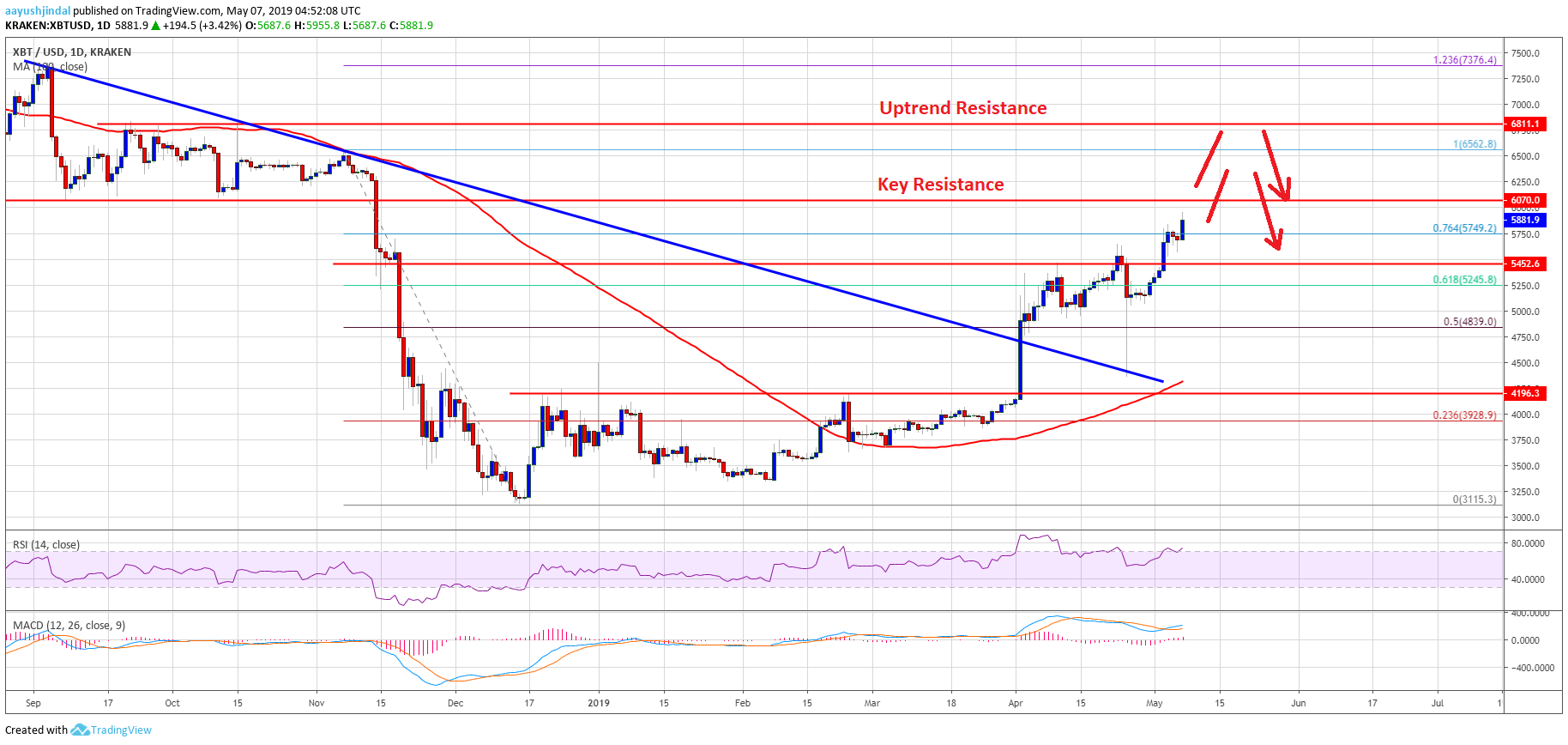
Looking at the chart, bitcoin price seems to be gaining pace above the $5,500 and $5,600 levels. Having said that, the bulls are likely to face a strong offer zone near $6,000, $6,070 and $6,100. If there is a successful close above $6,100, the price may climb higher towards $6,500 or even $6,800 before starting a substantial downside correction. On the downside, there are many supports near $5,540, $5,450 and $5,250. Below these, the price may revisit $5,000.
Technical indicators:
Daily MACD – The MACD is gaining bullish momentum with many positive signs.
Daily RSI (Relative Strength Index) – The RSI for BTC/USD climbed above the 70 level and it seems to be heading towards the 80 level.
Monthly Support Levels – $5,450 followed by $5,250.
Monthly Resistance Levels – $6,070, $6,500 and $6,800.
What is Blockchain Technology?
Posted by CoinDesk
“The practical consequence […is…] for the first time, a way for one Internet user to transfer a unique piece of digital property to another Internet user, such that the transfer is guaranteed to be safe and secure, everyone knows that the transfer has taken place, and nobody can challenge the legitimacy of the transfer. The consequences of this breakthrough are hard to overstate.”
– Marc Andreessen
From a cruising altitude, a blockchain might not look that different from things you’re familiar with, say Wikipedia.
With a blockchain, many people can write entries into a record of information, and a community of users can control how the record of information is amended and updated. Likewise, Wikipedia entries are not the product of a single publisher. No one person controls the information.
Descending to ground level, however, the differences that make blockchain technology unique become more clear. While both run on distributed networks (the internet), Wikipedia is built into the World Wide Web (WWW) using a client-server network model.
A user (client) with permissions associated with its account is able to change Wikipedia entries stored on a centralized server.
Whenever a user accesses the Wikipedia page, they will get the updated version of the ‘master copy’ of the Wikipedia entry. Control of the database remains with Wikipedia administrators allowing for access and permissions to be maintained by a central authority.

Wikipedia’s digital backbone is similar to the highly protected and centralized databases that governments or banks or insurance companies keep today. Control of centralized databases rests with their owners, including the management of updates, access and protecting against cyber-threats.
The distributed database created by blockchain technology has a fundamentally different digital backbone. This is also the most distinct and important feature of blockchain technology.
Wikipedia’s ‘master copy’ is edited on a server and all users see the new version. In the case of a blockchain, every node in the network is coming to the same conclusion, each updating the record independently, with the most popular record becoming the de-facto official record in lieu of there being a master copy.

Transactions are broadcast, and every node is creating their own updated version of events.
It is this difference that makes blockchain technology so useful – It represents an innovation in information registration and distribution that eliminates the need for a trusted party to facilitate digital relationships.
Yet, blockchain technology, for all its merits, is not a new technology.
Rather, it is a combination of proven technologies applied in a new way. It was the particular orchestration of three technologies (the Internet, private key cryptography and a protocol governing incentivization) that made bitcoin creator Satoshi Nakamoto’s idea so useful.

The result is a system for digital interactions that does not need a trusted third party. The work of securing digital relationships is implicit — supplied by the elegant, simple, yet robust network architecture of blockchain technology itself.
Defining digital trust
Trust is a risk judgement between different parties, and in the digital world, determining trust often boils down to proving identity (authentication) and proving permissions (authorization).
Put more simply, we want to know, ‘Are you who you say you are?’ and ‘Should you be able to do what you are trying to do?’
In the case of blockchain technology, private key cryptography provides a powerful ownership tool that fulfills authentication requirements. Possession of a private key is ownership. It also spares a person from having to share more personal information than they would need to for an exchange, leaving them exposed to hackers.
Authentication is not enough. Authorization – having enough money, broadcasting the correct transaction type, etc – needs a distributed, peer-to-peer network as a starting point. A distributed network reduces the risk of centralized corruption or failure.
This distributed network must also be committed to the transaction network’s recordkeeping and security. Authorizing transactions is a result of the entire network applying the rules upon which it was designed (the blockchain’s protocol).
Authentication and authorization supplied in this way allow for interactions in the digital world without relying on (expensive) trust. Today, entrepreneurs in industries around the world have woken up to the implications of this development – unimagined, new and powerful digital relationshionships are possible. Blockchain technology is often described as the backbone for a transaction layer for the Internet, the foundation of the Internet of Value.
In fact, the idea that cryptographic keys and shared ledgers can incentivize users to secure and formalize digital relationships has imaginations running wild. Everyone from governments to IT firms to banks is seeking to build this transaction layer.
Authentication and authorization, vital to digital transactions, are established as a result of the configuration of blockchain technology.
The idea can be applied to any need for a trustworthy system of record.
Authored by Nolan Bauerle; images by Maria Kuznetsov
https://www.coindesk.com/information/what-is-blockchain-technology
Two Big Tests For Bitcoin
Photographer: Tomohiro Ohsumi/Bloomberg
Bitcoin, the digital currency that has turned into the new “gold” among investors and traders around the world, is in for two big tests. The first test is simple, and involves Bitcoin’s price chart. The digital currency must overcome the barrier of the $5000-mark, which it already crossed last night before pulling back towards the $4800-mark. Milestone numbers are important for traders following price and volume charts, as they confirm/reject market momentum.
The second test is more complicated. It involves the actions of big governments that have been following with great unease the rising in popularity of Bitcoin and other cryptocurrencies that threaten to abolish their monopoly in creating money and collecting seigniorage income.
Back at the end of July, the SEC ruled that cryptocurrency “IPOs” or Initial Coin Offerings (ICOs) are investments, and therefore, should be subject to the same rules as regular stocks.
That ruling sent all major cryptocurrencies sharply lower, before rebounding towards new highs.
| Coin/Investment Trust | Change 24H |
| Bitcoin (BTC) | -9.10% |
| Ethereum (ETH) | -11.20 |
| Litecoin (LTC) | -8.34 |
| Bitcoin Investment Trust Shares (GBTC) | -5.39 |
7/26/2017
Apparently, traders and investors thought that this ruling could eventually be positive for cryptocurrencies, as it will limit the supply of new digital currencies coming to the market. Thus, the new high reached overnight for Bitcoin.
Now comes the National Internet Finance Association of China (NIFA) to warn investors that ICO projects are a threat to the stability of China’s financial sector.
China and Asia are among the biggest markets for Bitcoin and any warning from Asian governments, especially from the Chinese government, shouldn’t be taken slightly.
That could, perhaps, explain the big sell off in most digital currencies on Saturday, though it is still too early to determine whether the sell-off was technical or fundamental.
My recent book The Ten Golden Rules Of Leadership is published by AMACOM, and can be found here.
https://www.forbes.com/sites/panosmourdoukoutas/2017/09/02/two-big-tests-for-bitcoin/#138e5fbd4473
Posted by
,
Contributor
What your company needs to know about the blockchain movement
Posted by

Image Credit: Pushish Images / Shutterstock
The blockchain technology market is projected to see a 61.5 percent compound annual growth rate through 2021 according to MarketWatch. And we’re seeing companies from across the spectrum — from finance, logistics, and manufacturing to research, computing, and insurance — looking to roll out blockchain projects. But what, exactly, is the appeal of this technology?
In general, there seem to be three driving factors:
1. Gartner’s prophesied digital mesh — the increased blending of people, devices, content, and services — grows more corporeal daily. The way people interact with businesses is evolving, as is the way businesses interact with each other. This blurring of traditional modes of communication and exchange is driven by digitalization and necessitates new business processes and models to cope with an increasingly connected world. Blockchain technology addresses these changes.
2. The new business models required to support this digital mesh are increasingly being built around decentralized networks. Third-party intermediaries and old B2B exchanges that reduce speed and agility don’t apply anymore. We’ve been consistently moving away from central clearinghouses, as partnerships and collaborative engagements at every level become more direct and peer-to-peer. Blockchain technology addresses these changes.
3. Peer-to-peer transactions still require security. There is a need for new technical capabilities to support security and integrity for decentralized networks, and to do so persistently. Blockchain technology addresses these changes.
The blockchain model
If you’re not already familiar with the blockchain model, this section’s for you. Broadly, blockchain works by consensus and may optionally include smart contracts (code within the network). There is no central authority or data store, and the chain is distributed across a peer-to-peer network of nodes and participants. During processing, transactions are added to a “block.” The block is replicated to all the participants that need to validate the transactions. The validated block is then added to the “chain.” The chain is key to the system’s value. Any block will contain a reference to its preceding block via a cryptographic hash. If anyone surreptitiously manipulates the content in a block, that hash will no longer be valid. This creates a kind of append-only data structure and tamper-proof audit log. In many ways, blockchain may be thought of as a decentralized data management platform and asynchronous, global publishing layer that provides:
- A distributed system of record. An immutable distributed ledger that lets you store and distribute information and manage peer-to-peer transactions amongst your decentralized network.
- Smart contracts. Organizations want to be able to automate processes between themselves — the generation, receipt, and exchange of transactions. Blockchain smart contracts execute business logic against transactions that can be executed “on-chain” automatically by participants. No central coordinator is required, and the code is run in parallel, reducing risk and increasing efficiency.
- Security and consensus. One of the most compelling aspects of the blockchain model is its inherent security. Because there is no central database to protect, there is no central database to attack. Blockchains can be structured against different contribution and access rights within a distributed network. For example, there are permissioned (or private) blockchains, wherein contributions to the system are restricted to specific actors and participants are highly trusted; and permissionless (or public) blockchains, wherein anyone can join and participate in the process of block verification and participants are anonymous and vastly dispersed. There is also a middle path, referred to as a “consortium” network, which typically is a private network operated by a group instead of a single organization.
Blockchains don’t work for all use cases
There are many use cases for blockchain in the enterprise: securely managing product provenance (the journey of an asset from raw material to manufactured goods), consumer contracts (insurance claims, real-estate transactions, utilities), and transaction exchanges (financial, health, energy, government). But blockchain isn’t appropriate for everything.
For some blockchain applications, significant questions still need to be resolved, including:
- How to get data in/out of the blockchain
- How to extend smart contract logic “off-chain”
- How to respond to events inside/outside the blockchain
- How to analyze data contained in the blockchain
- How to control and manage access to the blockchain
In short, there are bidirectional interactions and integration points between enterprise systems and a blockchain to consider. A map of which might look like this:

When you need a blockchain — and when you don’t
Tools and technologies are emerging and being extended to help introduce blockchain into a larger operational fold. But even with an appropriate integration strategy, not every problem requires a blockchain! Here are some issues to consider:
- Number of participants in a network (if it’s only two parties, there’s probably not much benefit to a blockchain)
- Required trust and integrity levels
- Amount of data storage (blockchain is generally not geared for storing large amounts of data, since every node across the distributed network often has an identical copy of the blockchain)
- Performance requirements and transaction processing times. Speed is a serious handicap — most blockchain stacks are not appropriate for any task or transaction with real-time requirements, given the nature of blockchain processing, validation, and consensus (e.g. bitcoin currently has a block time of about 10 minutes).
While it isn’t magic and it doesn’t suit every use case, blockchain does present an interesting model for trusted exchange and collaboration in our increasingly networked and digitized world. The only sure way to determine if it is applicable to your organization’s needs is to experiment with it yourself.
Nelson Petracek is CTO of the Strategic Enablement Group at TIBCO Software.
What your company needs to know about the blockchain movement
Bitcoin’s Biggest Software Wallet Blockchain Adds Ethereum
Bitcoin wallet startup Blockchain is today launching an option for users to create ethereum software wallets, a move that marks the first time the startup has integrated a new cryptocurrency since it launched in 2011.
Announced today, the launch also coincides with a new partnership with cryptocurrency exchange service ShapeShift that will enable users to transition funds between their bitcoin and ethereum wallets, without first needing to send funds to a centralized service.
But while Blockchain executives largely kept the focus on how this would enable retail users to continue to experiment with cryptocurrencies, in comments, they also hinted at the possible business applications that could be available should the service.
CEO Peter Smith said in a statement:
“As popularity of ethereum has grown, so has the desire from our customers to have the option to manage multiple digital assets within their blockchain wallets. We are thrilled to introduce this new functionality to our community and will continue to find ways to make interacting with digital assets even easier.”
Elsewhere, the company said it is open to offering other services to ethereum users, hinting its data tools could soon see an overhaul. Also mentioned was the possibility that a software wallet could be available to business users.
The company said its release today is not designed for developers or companies.
Nonetheless, such advancements could be propelled forward by new funding. Blockchain recently raised $40 million in a Series B funding round, drawing from a group of investors that included billionaire Richard Branson. The startup has raised more than $70 million to date in venture funding, according to CoinDesk data.
More broadly, it’s also the latest sign bitcoin businesses are now adapting their business models to support multiple blockchains.
Other services have moved to integrate ether in recent days, including cryptocurrency exchange Bitstamp and Falcon Private Bank, a Swiss-based private bank that added support for ether just over a month after it first began offering bitcoin services.
Disclosure: CoinDesk is a subsidiary of Digital Currency Group, which has an ownership stake in Blockchain and ShapeShift.
Peter Smith image via CoinDesk
https://www.coindesk.com/blockchain-adds-ether-to-its-bitcoin-wallet-service/
Posted by
Stan Higgins Aug 17, 2017 at 16:59 UTC
 365 Stock market news